
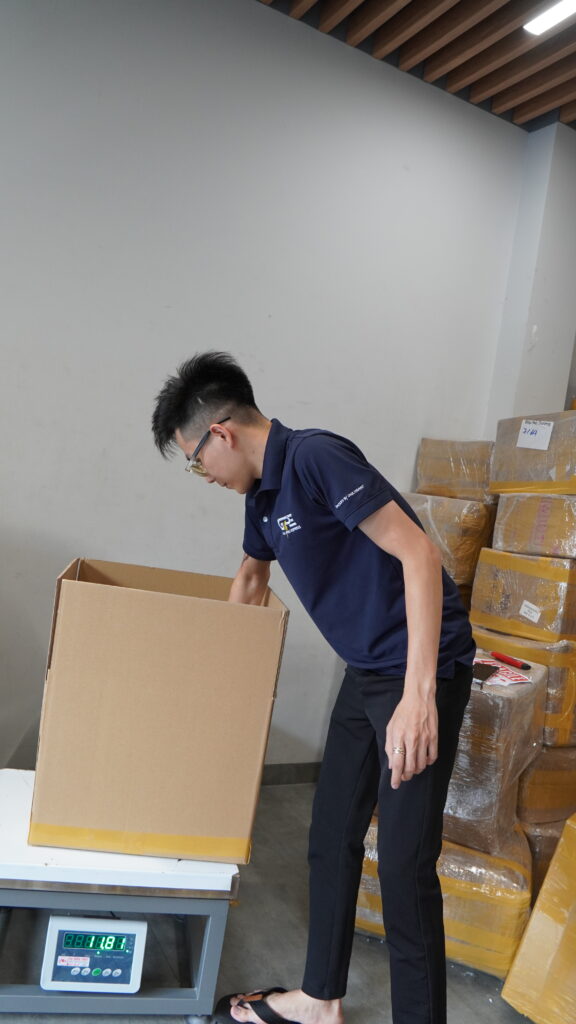
"This box is about 10 kg" is the starting information, but to check the postage to the Philippines you also need measurements after packaging. Weight indicates how much the package weighs; three dimensions show how much space the package takes up.
1. Weigh when the packaging is complete
Place the scale on a flat surface, check the number 0 and then weigh the entire package including goods and packaging. If you do not have a suitable scale, please state clearly that you do not have a scale; an estimated value should be recorded as an estimate. Do not claim it is the final weight.
Packages with wooden frames, pallets or reinforcements need to be counted with the packaging when checking. If you later add material or stock, weigh and measure again. The same item but different packaging may create different package data.
2. Measure the outermost three dimensions
- Place the package in the expected packing position.
- Measure length, width and height at the outermost part, including the bulge.
- Write cm units on each line, do not mix cm with mm.
- Take photos with a ruler if needed for comparison.
For goods that are not evenly shaped, send additional photos for instructions on how to take measurements. Don't indicate "large suitcase size", as the sizes of two suitcases can vary significantly.
3. CBM is volume, not rate
For rectangular packages, the volume in cubic meters is calculated by length × width × height, when all three dimensions are converted to meters. If using cm, divide the three-dimensional product by 1,000,000.
This result does not indicate the amount to be paid. Rate calculation, minimums, rounding, product type and service scope still need to be confirmed. Do not multiply CBM by any price on another route.
4. How is the volumetric weight different from the actual weight?
Some delivery services compare actual weight with volumetric weight to determine chargeable weight. For example, DHL Express publishes a conversion formula using cm size divided by 5,000. Source: DHL Weight and Dimensions.
This is an example of a sourced service, not the default for the entire Philippine service of Gia Phú. You should ask clearly whether the reported plan is calculated by actual kg, converted kg, CBM or package, and how it applies to multiple packages.
5. Short list for consulting messages
| Case | Weight | Length × width × height | Notes |
|---|---|---|---|
| 1 | … kg | … × … × … cm | What product, what packaging In what way is |
| 2 | … kg | … × … × … cm | different from case 1? |
Send with address in the Philippines and product photos. If the packages are not the same, do not multiply the size of one package by all. Total weight and total volume should only be added after each line has the correct data.
Three common mistakes to avoid
- Weighs only products: missed the packaging so the consultation number is different from the delivery number.
- Record missing units: 600 mm and 600 cm are two completely different sizes.
- Call CBM the number of kg: volume does not change directly into kilograms for billing if the service rules are unknown.
If you want to choose the method after you have the measurements, see compares Air and Sea for goods to the Philippines. If packaging needs to be adjusted, see packing checklist before closing the final number.
Need to check a shipment to the Philippines?
See route information and price list at Gia Phú Express shipping page to the Philippines. You can call 097 186 7777 or message Zalo for exchange according to actual package.